

Welcome to the Parish of St Michael with St Mary, site of the oldest known Christian activity in the British Isles.
Latest Parish News & Notices


Feature Stories
On St Dunstan’s Day our Vicar, Jonny Lloyd, shows us into the bell chamber for a look at St Michael’s eight bells. Click to play. The video is best viewed ‘full screen’.
Sir Francis Bacon 400th Anniversary
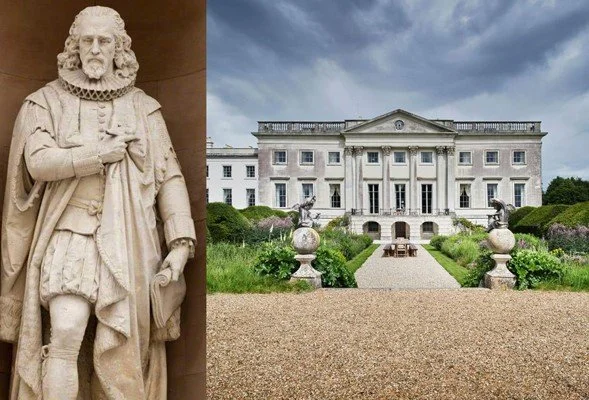
2026: A Significant Commemoration
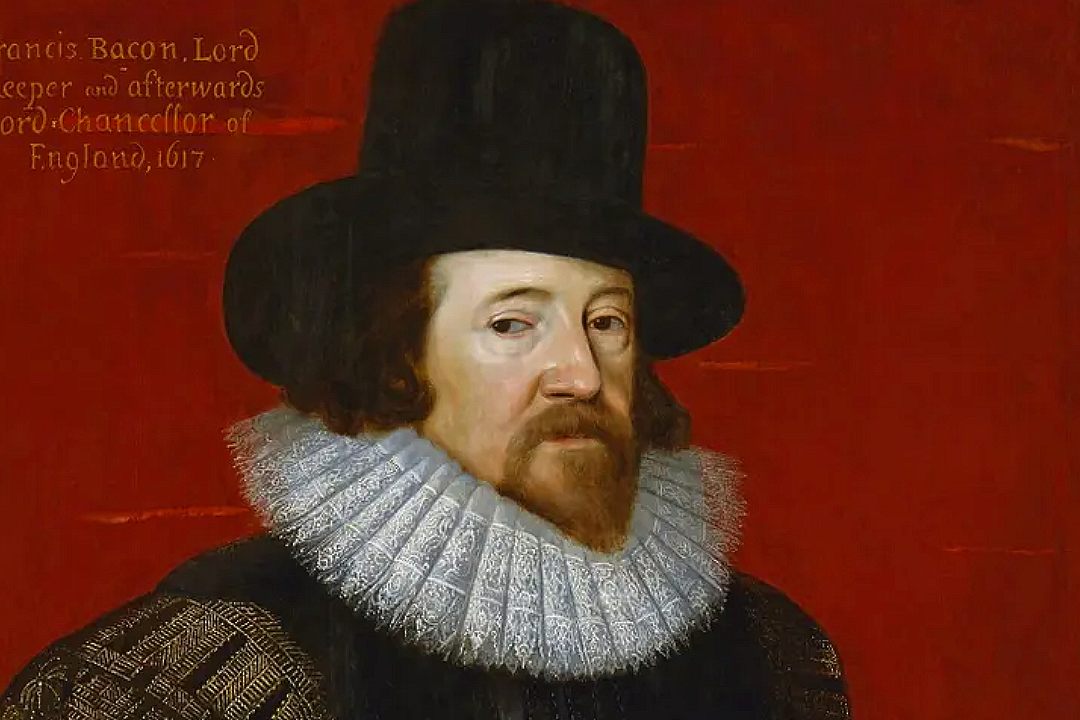
2026 marks the 400th anniversary of the death of Sir Francis Bacon, one of history’s greatest philosophers, scientists, and statesmen. As his home and final resting place, St Albans will be the focal point for global commemorations, featuring lectures, exhibitions, and community activities that celebrate his enduring legacy.
From groundbreaking contributions to the scientific method to his influence on modern thought, this anniversary is an opportunity to reflect on Bacon’s impact and explore his lasting significance in today’s world.
To find out more about key events and celebrations visit bacon400.com
Here you can find out everything celebrating the 400th anniversary of Sir Francis Bacon’s legacy.
Sir Francis Bacon 400th Anniversary
Sir Francis Bacon - A Life in Six Acts
Transcript of a talk given by the Rev. Jonathan Lloyd to the Society of Kingsbury and St Michael
"A wise man will make more opportunities than he finds." Who said that? "Knowledge itself is power."
"Nature, to be commanded, must be obeyed."
Good evening, everyone. I am here to tell you about a man who, depending on who you ask, was the father of modern science, the greatest legal mind of his age, a shameless social climber, a neglectful husband, a convicted criminal, and the author of Shakespeare's plays. We won't be settling that last one tonight. But everything else? That's all true, sometimes all at once.
This is the story of Sir Francis Bacon. And I want to tell it to you not as a list of achievements, but as what it actually was — a climb, a marriage, a betrayal, a collapse, and then, strangely, the most productive few years of his life happened only after he'd lost everything that mattered to him. So let's start at the beginning.
1. Origin Story
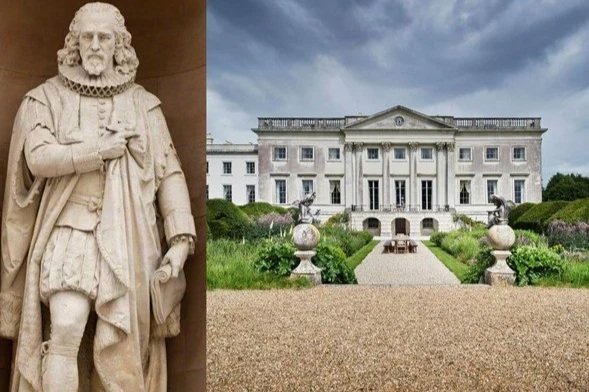
Francis Bacon was born in 1561, in York House on the Strand in London, into a family that was about as close to the centre of power as you could be. His father, Nicholas Bacon, who built Gorhambury, was Lord Keeper of the Great Seal — essentially one of the most senior legal officers in England, a man who guarded the monarch's official seal and with it, a huge amount of administrative power. His mother, Anne Cooke, was formidably well-educated — she translated theology from Italian and Latin, was a valued member of Queen Mary’s court even though a staunch Protestant, and she made sure Francis and his brother Anthony were steeped in languages and ideas from the cradle.
So young Francis grows up surrounded by statecraft. He was a small, sickly child, but bright. There's a lovely, possibly embellished story that Queen Elizabeth the First used to call him “the young Lord Keeper” because of how seriously and cleverly he spoke, even as a boy.
He started his education probably with Anne’s chaplains, then he went up to Cambridge at twelve years old. Twelve. And it's there that he apparently first turned against the Aristotelian philosophy that dominated the curriculum — he found it sterile, argumentative for argument's sake, disconnected from anything useful in the real world. That irritation never left him, and decades later it became the seed of his entire philosophical project.
At fifteen, he was sent to France with the English ambassador, getting a diplomat's education in real time and probably working as a spy with his brother Anthony. And then — disaster. His father died suddenly in 1579, before he'd finalized the financial provisions he'd intended for Francis. Francis, the youngest son, was left with comparatively little money and no land. So here's our origin story in a sentence: a brilliant boy, raised in the corridors of power, watching his older relatives wield enormous influence — and then suddenly cut loose without the money or title to claim any of it for himself.
That gap, between the world he felt entitled to and the world he could actually afford, is going to drive almost everything that follows.
2. The Winding Stair to Power
Bacon himself once wrote that “all rising to great place is by a winding stair” — and perhaps nobody illustrated that better than he did. He trained as a lawyer at Gray's Inn, was called to the bar, and entered Parliament at twenty-three. And then he spent the next two decades doing something quite remarkable: working his way upwards, slowly, through sheer persistence, talent, brilliance, and the unenviable need to be sycophantic of people he probably couldn’t stand!
His first major patron was his own uncle, William Cecil, Lord Burghley — Elizabeth's chief minister. You'd think that would be enough. It wasn't, partly because Burghley seems to have been quietly grooming his own son, Robert Cecil, for the top jobs, and wasn't especially eager to help his nephew leapfrog him. So Bacon was forced to pivot to a second, even more prominent patron: the Earl of Essex, Robert Devereux, the Queen's glamorous favourite. Essex adored Bacon, lobbied hard for him, even tried to give him a substantial gift of land when royal appointments didn't come through.
And here's where the story gets morally complicated, and it's worth sitting with. When Essex later launched a reckless, half-baked rebellion against Elizabeth in 1601, Bacon — his friend, his beneficiary — was one of the lawyers who prosecuted him for treason. Essex was executed. Bacon even wrote the official government pamphlet justifying it afterward. People at the time were scandalized. Was it cold self-preservation? Genuine belief that Essex's actions threatened the state? Probably both, in some uncomfortable combination. Or the fact that if a great man fell, and fall they often did, all his household fell with him if they weren’t careful. Bacon was a realist about the world, saw its flaws and later as we’ll see, dreamed of ways to improve it. But it tells you something essential about Bacon: when his career and his personal loyalties collided, he was prepared to act swiftly in his own interest.
The prosecution against Essex worked, and Bacon survived. When Elizabeth died in 1603 and James the First came to the throne, Bacon courted the new king and his favourites, and began climbing in earnest. Knighted in 1603. Solicitor General in 1607. Attorney General in 1613. And finally, in 1618, he reached the absolute summit: Lord Chancellor of England, a higher office than even his father had held, and a peerage to go with it — Baron Verulam, later Viscount St Alban. The winding stair had reached the top.
3. Villains of the Tale
Bacon's Relationship with Coke and Buckingham
No climb that long happens without friction, and Bacon had two relationships that shaped — and ultimately wrecked — his career. Interestingly, they sit at opposite ends of the power spectrum: one was a rival who out-argued him for years, the other was a patron who eventually couldn't, or wouldn't, save him.
First, Sir Edward Coke. If Bacon was a philosopher who happened to practice law, Coke was the opposite — a ferociously brilliant, combative common lawyer who became Bacon's great professional rival for almost their entire careers. They competed for the same offices repeatedly. They even, at one point, courted the same wealthy widow — Bacon lost that one too. Coke beat him to Attorney General. Bacon was supported by now by Devereux (who would be Essex), who waged a constant war against Robert Cecil for control of the English government. The position of Master of the Rolls had become vacant in April 1593, and Coke was expected to be appointed according to convention; Bacon, therefore, would become Attorney General. Coke reacted by becoming even more dogmatic in his actions on behalf of the Crown, and when Devereux approached the queen on Bacon's behalf, she replied that even Bacon's uncle Lord Burghley considered him the second best candidate, after Coke.
Coke represented, in almost every philosophical sense, what Bacon thought was wrong with English law: rigid precedent, defensive of judicial independence sometimes to the point of obstruction, resistant to the king's authority in ways Bacon found dangerously destabilizing. Bacon, by contrast, generally sided with expanding royal prerogative. Their feud was personal and ideological at once, and it ran for thirty years. And — delicious historical irony — it was Coke who eventually got his revenge, helping orchestrate the parliamentary investigation that brought Bacon down, and as a result accidentally securing Bacon’s legacy for generations to come. We'll get there.
The second figure is George Villiers, Duke of Buckingham — he appeared later in the story and was King James's extraordinarily powerful favourite, a man who rose from minor gentry to become essentially the most influential person in England after the king himself.
Bacon, ever the strategist, attached himself to Buckingham as a mentor and ally, writing him long letters of advice, helping advance his interests, hoping — reasonably, by the rules of the patronage system — that Buckingham's favour would be his protection.
And for a while it was. But patronage cuts both ways. The King’s enemies in Parliament, unable to challenge James himself, came after Buckingham and Bacon in 1621. Bacon was the safer, more isolated target, a step further from the King. And when the moment of crisis came, Buckingham did not throw himself in front of the charges to save his old mentor. He let Bacon fall. Coke supplied the legal machinery of Bacon's downfall; Buckingham supplied the absence of protection. Between them, that was more than enough to get Bacon sent to the Tower.
4. Unhappy Marriage
Let's step out of the courtroom and into the household for a moment. This matters if we are to follow the course of what happened to Bacon’s body!
In 1606, at forty-five, Bacon married Alice Barnham, a fourteen-year-old alderman's daughter with a substantial dowry. Yes, fourteen — startlingly young even by the standards of the period, though the marriage wasn't consummated and she didn't live with him as his wife for some time afterward, which was itself a recognized practice. He needed the money; her family wanted the connection. It was, in other words, a transaction first and a marriage second, which was extremely normal for the era but worth naming plainly.
It does not appear to have become a particularly warm partnership. There are no surviving love letters, no real evidence of affection in either direction, and historians have long speculated — based on patterns in his life, his lack of interest in producing an heir, and the company he kept — that Bacon's emotional and possibly romantic attachments lay elsewhere, particularly toward men in his household and service. None of this can be stated with full certainty; the sources are thin and contested. What we do know for certain is the ending: in his will, Bacon revoked virtually everything he'd left to Alice, after discovering she had begun a relationship with one of his own household officers, a man named John Underhill, even before Bacon had died. It's a quietly devastating coda — a marriage that began as a financial arrangement and ended, by all appearances, in mutual estrangement and a final, bitter act of disinheritance.
5. Fall from Grace
Anyway, we return to the political story. In 1621, at the absolute peak of his power as Lord Chancellor, Bacon was brought down by Parliament on charges of bribery — specifically, accepting gifts from litigants whose cases were before his court.
A few things are important to understand about this. First, the practice of receiving gifts from litigants was extremely common in the legal culture of the time; it wasn't really seen, by Bacon or many of his peers, as fundamentally different from a tip or a customary courtesy, especially if it didn't actually change the outcome of the verdict. Second, Bacon's enemies — Coke very much included — were circling, and Parliament was newly assertive and looking for a high-profile target to demonstrate its power against corruption at court, partly as a political manoeuvre against the wider patronage system operated by the Royal Household that protected men like Buckingham. Bacon was, in that sense, somewhat unlucky: he was prosecuted with real intensity for behaviour that had quietly been tolerated in others for generations.
But — and this matters — Bacon did not mount a vigorous defence. When the charges were laid out before the House of Lords, he didn't contest the facts in detail. He wrote, with striking directness, that he was “guilty of corruption” and threw himself on the mercy of his peers, asking only that they be merciful in the manner, not the substance, of his punishment. It's an extraordinary moment — the great philosopher of inductive reasoning and careful evidence-weighing simply declining to litigate his own case. Why did he allow this to happen? That’s the great question. Was this a final act of service to a king whose authority he respected to the debasement of his own life? Was there a background deal worked by Buckingham to take the heat off himself and the King?
The punishment was severe on paper: a fine of forty thousand pounds, an enormous sum; imprisonment in the Tower of London at the King's pleasure; permanent disqualification from holding any office, sitting in Parliament, or even coming within the verge of the court. In practice, the king quickly suspended the fine and Bacon's time in the Tower lasted only a few days. The deal worked through. But the public disgrace was total and irreversible. The Lord Chancellor of England, the man who'd spent forty years climbing that winding stair, was finished as a public figure, in a single, swift parliamentary process. He was sixty years old.
6. Productive Failure
The Last Few Years
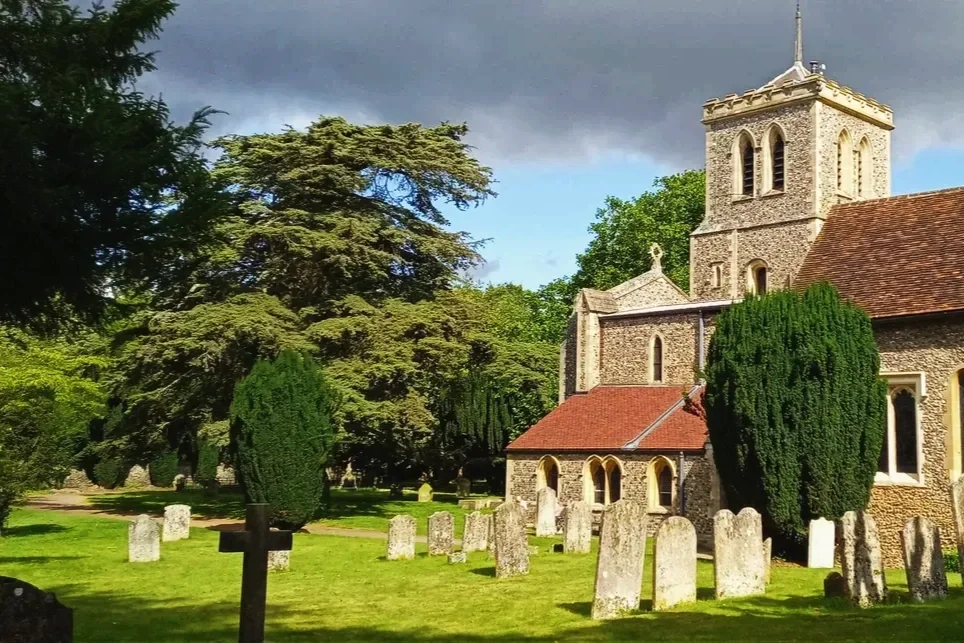
And here is the part of the story the is closest to us here in St Michael’s parish.
Stripped of office, banned from court and Parliament, carrying enormous debts, Bacon retired to his estate at Gorhambury — and instead of disappearing into bitterness, he had the most intellectually productive period of his entire life. Politics had been the thing standing between Bacon and the work he arguably cared about most: building a new method for human knowledge itself.
In these final five years, he revised and expanded the Essays into their richest and final form. He wrote The History of the Reign of King Henry the Seventh, a genuinely innovative work of historical biography. He produced significant portions of his great unfinished project, the Instauratio Magna — the “Great Renewal” of human learning — including pushing forward the ideas that would crystallize as the New Atlantis, his utopian vision of a society organized around scientific research and collaborative experimentation, which would go on to directly inspire the founding of the Royal Society decades later. The man who'd spent his whole career chasing offices spent his last years laying philosophical groundwork for the entire scientific method as we still broadly understand it today — careful observation, structured experiment, and a deep suspicion of inherited assumptions.
And then, in April 1626, we come to the end. His chaplain and confidant, Dr William Rawley, wrote in his account that on the 9th of April, the day celebrated for our Saviour’s resurrection (Easter) at the Earl of Arundel’s house in Highgate, he died of a ‘gentle fever, accidentally accompanied of a great cold, whereby the defluxion of rheum fell so plentifully upon his breast that he died by suffocation.’ John Aubrey in his ‘Brief Lives’ gives a little more detail, which I hope is true, that Bacon was testing a theory about whether snow could be used to preserve meat, the way salt does. He stopped his coach, bought a chicken, and stuffed it with snow himself, by hand, in the cold, to see what would happen. He caught a severe chill from the exposure, developed what was probably bronchitis or pneumonia, and died a few days later. Even his death was an experiment.
So that's Francis Bacon. A man who spent decades climbing toward power through genuinely uncomfortable compromises — sacrificing a friend, courting the right patrons, marrying for money rather than affection — and who, when all of that collapsed in public disgrace, turned out to have his greatest legacy waiting on the other side of the fall.
We remember the Essays. We remember the New Atlantis. We remember him, fairly or not, as one of the architects of the modern world.
Postscript – where’s the body???
So where’s the body? Good question. We know Sir Thomas Meuty’s, Bacon’s secretary and executor had him buried according to his wishes in the chancel of St Michael’s church, and in 1630 caused the statue of Bacon we see today to be carved. He was granted a lifetime interest in Gorhambury, and married Anne Bacon, a granddaughter of one of his half-brothers from Suffolk. Meutys died in 1649 and was buried beside Bacon in the rapidly filling vault under our chancel. She married again in 1651, this time Sir Harbottle Grimston who purchased the right to Gorhambury and outlived Anne. In 1681 he had Bacon’s coffin moved to make space for his own (which would come 5 years later) and we have no record of where it was moved to! Probably elsewhere on the consecrated ground of the church but that is the final mystery.
But as my final act this evening I make a promise to you, solemnly, that if I find it while hoovering one day, you will be the first to know.
To find out more about key events and celebrations visit bacon400.com Here you can find out everything celebrating the 400th anniversary of Sir Francis Bacon’s legacy.
Sir Francis Bacon 400th Anniversary Exhibition
Now on at St Michael’s Church until September 2026
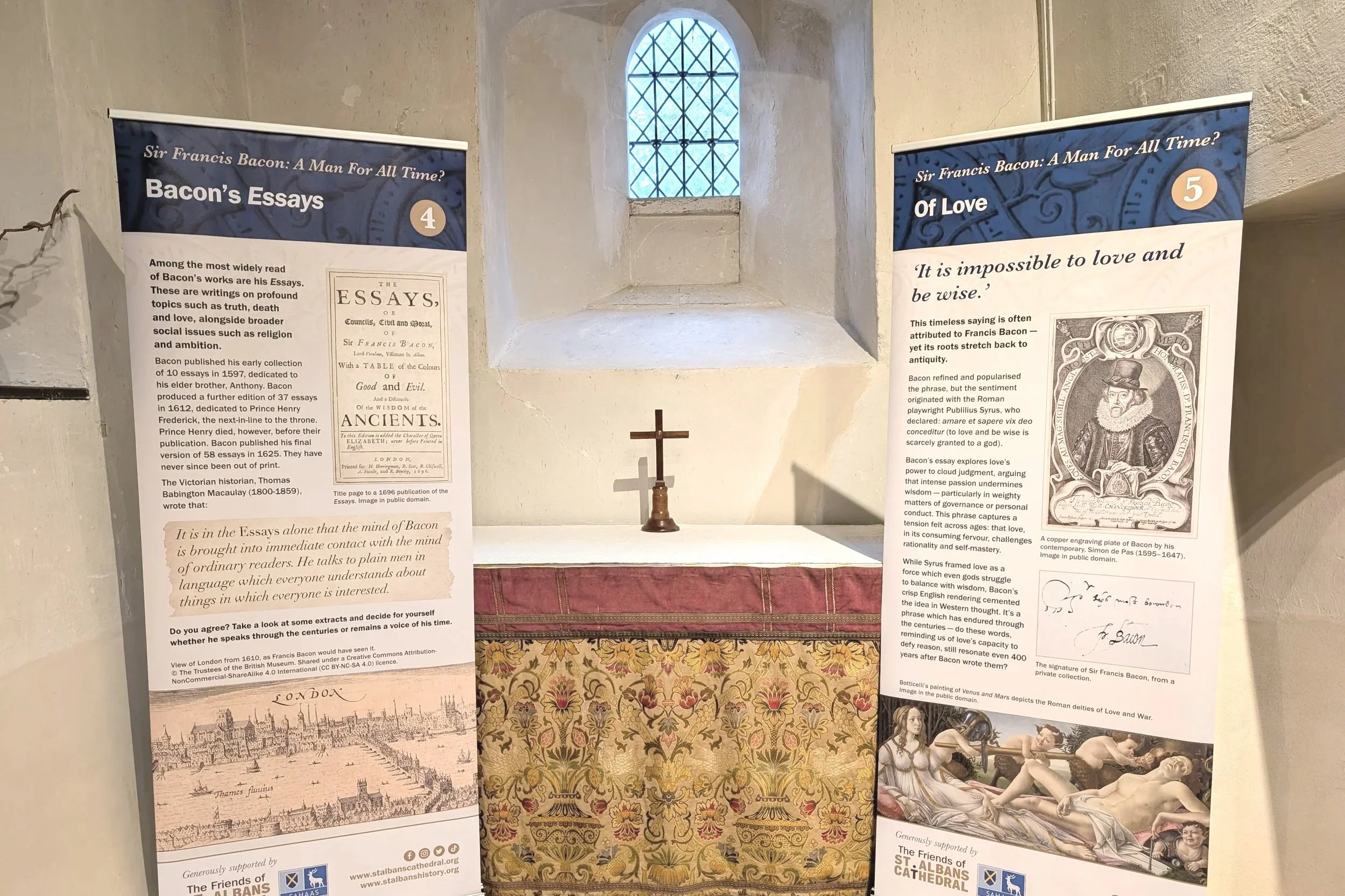
As part of the Sir Francis Bacon 400th Anniversary, St Michael’s Church has an excellent exhibition covering different aspects of his life and works running until September this year. The panels are situated throughout the church.
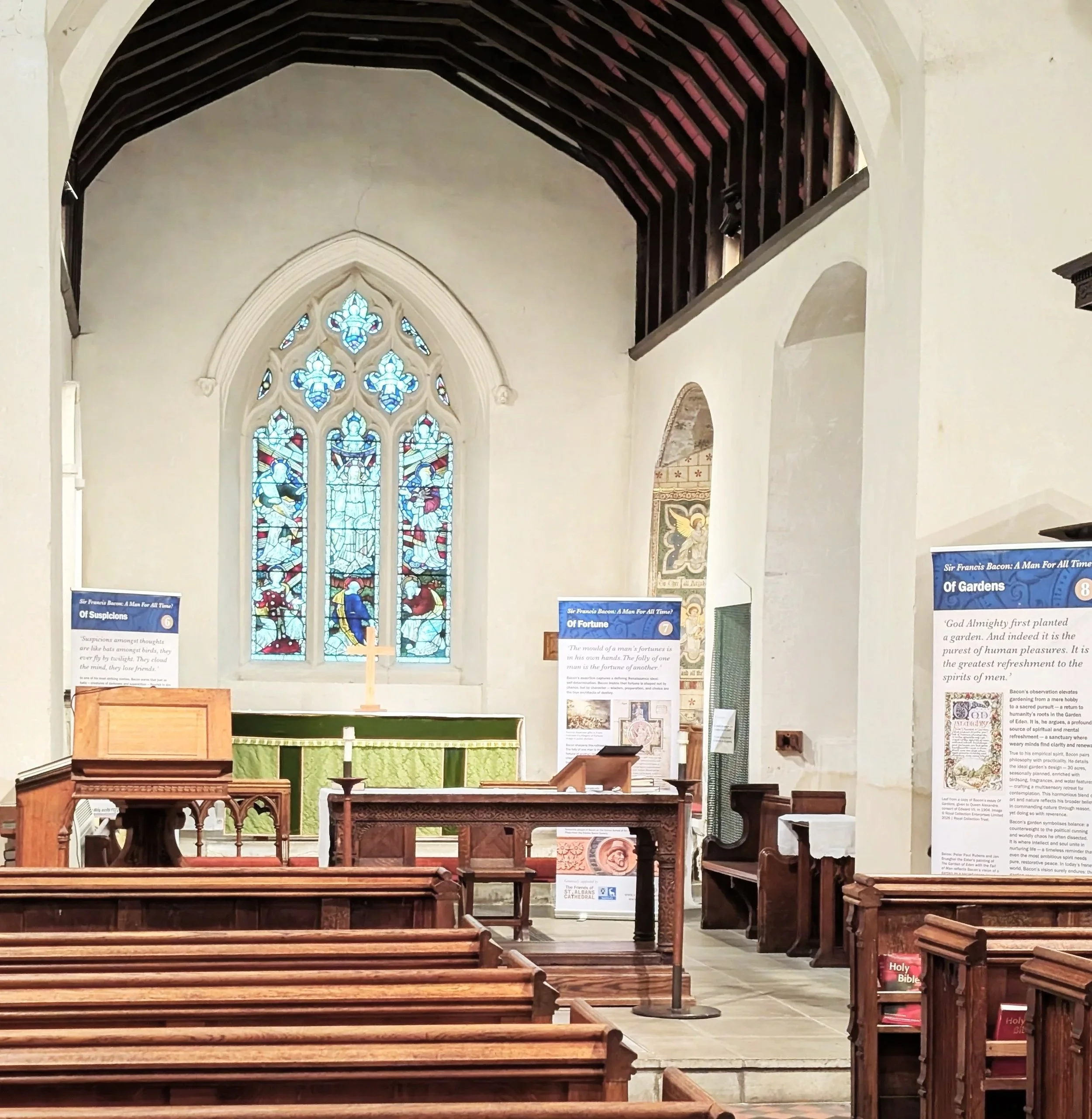
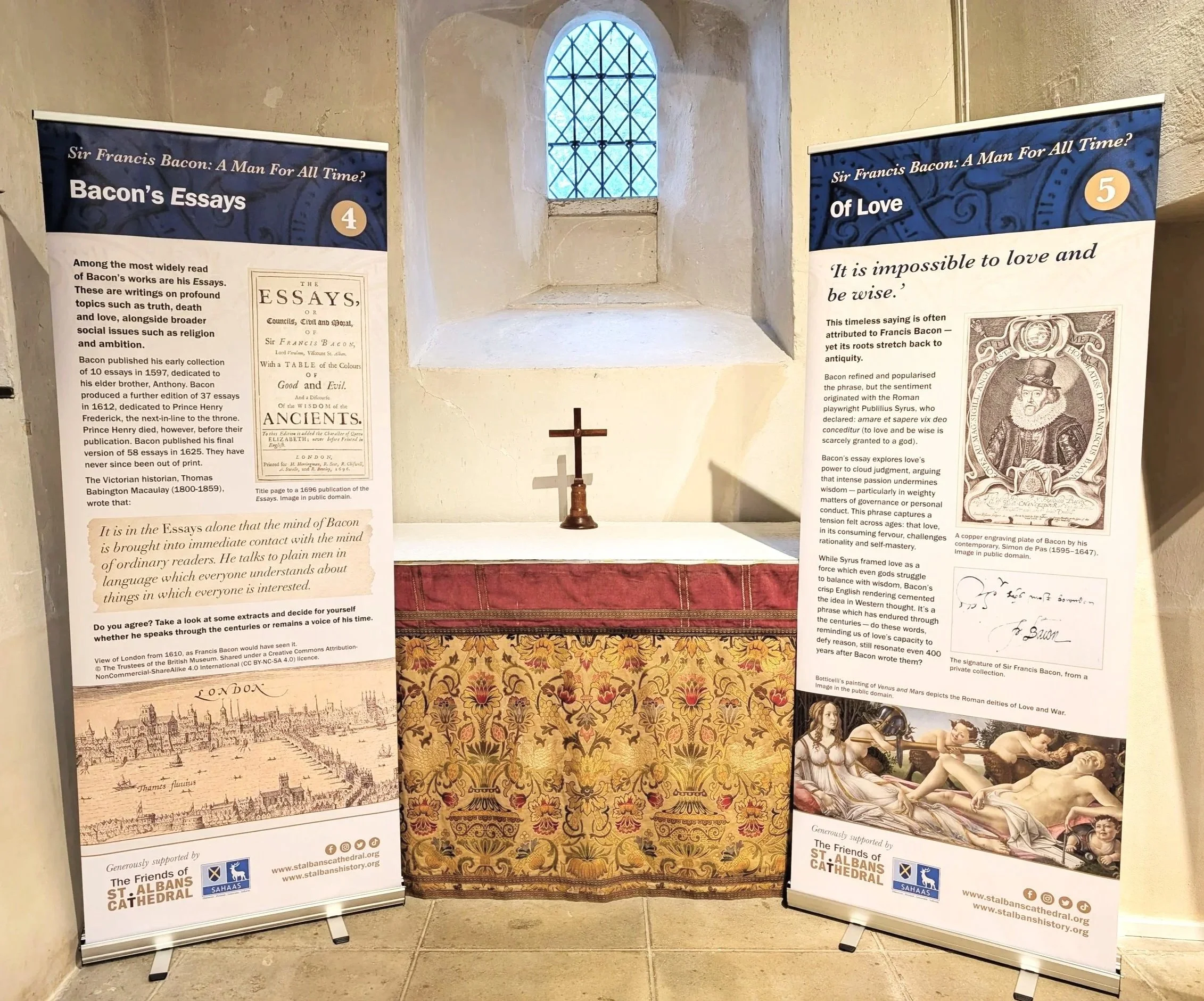
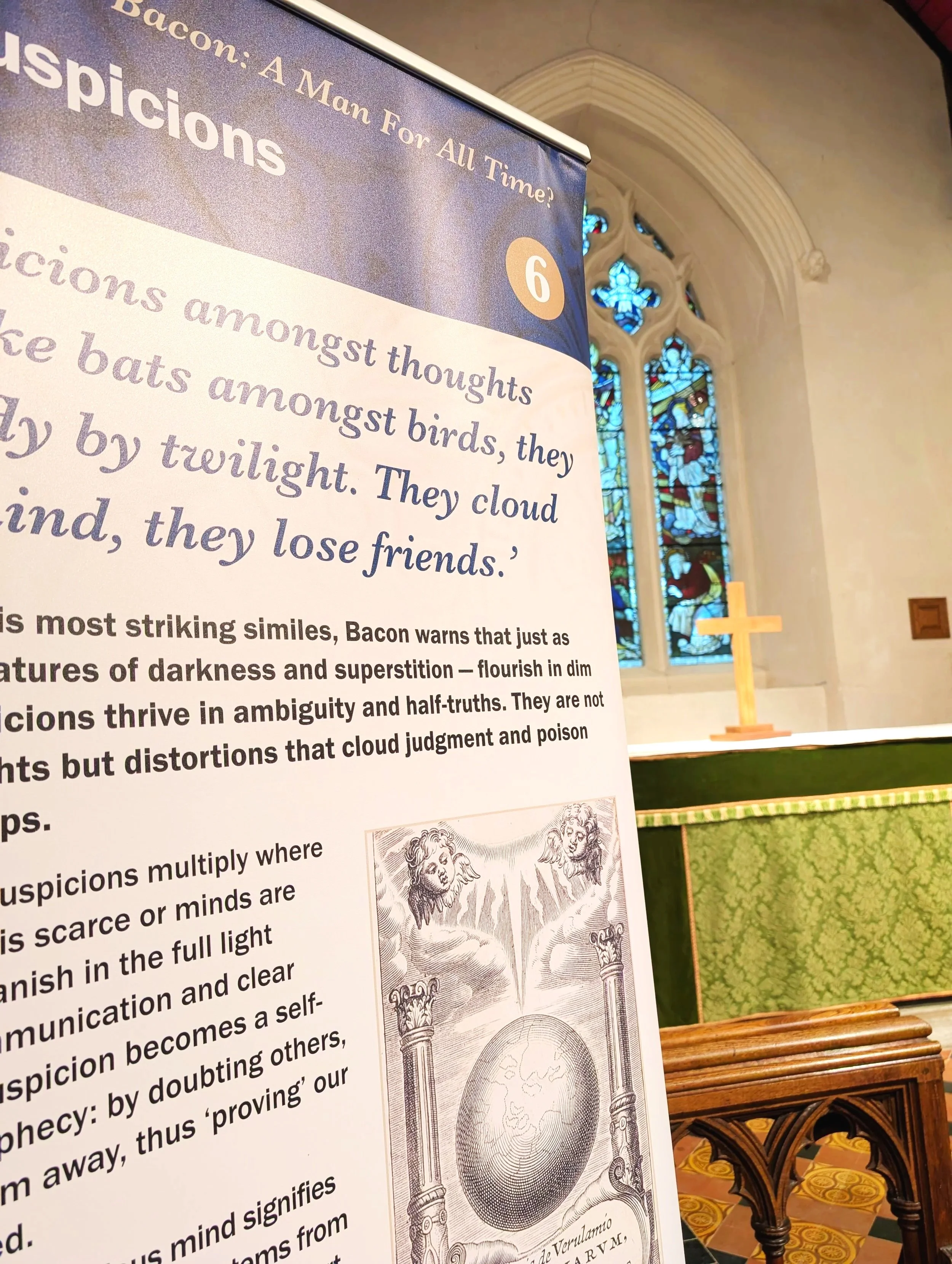
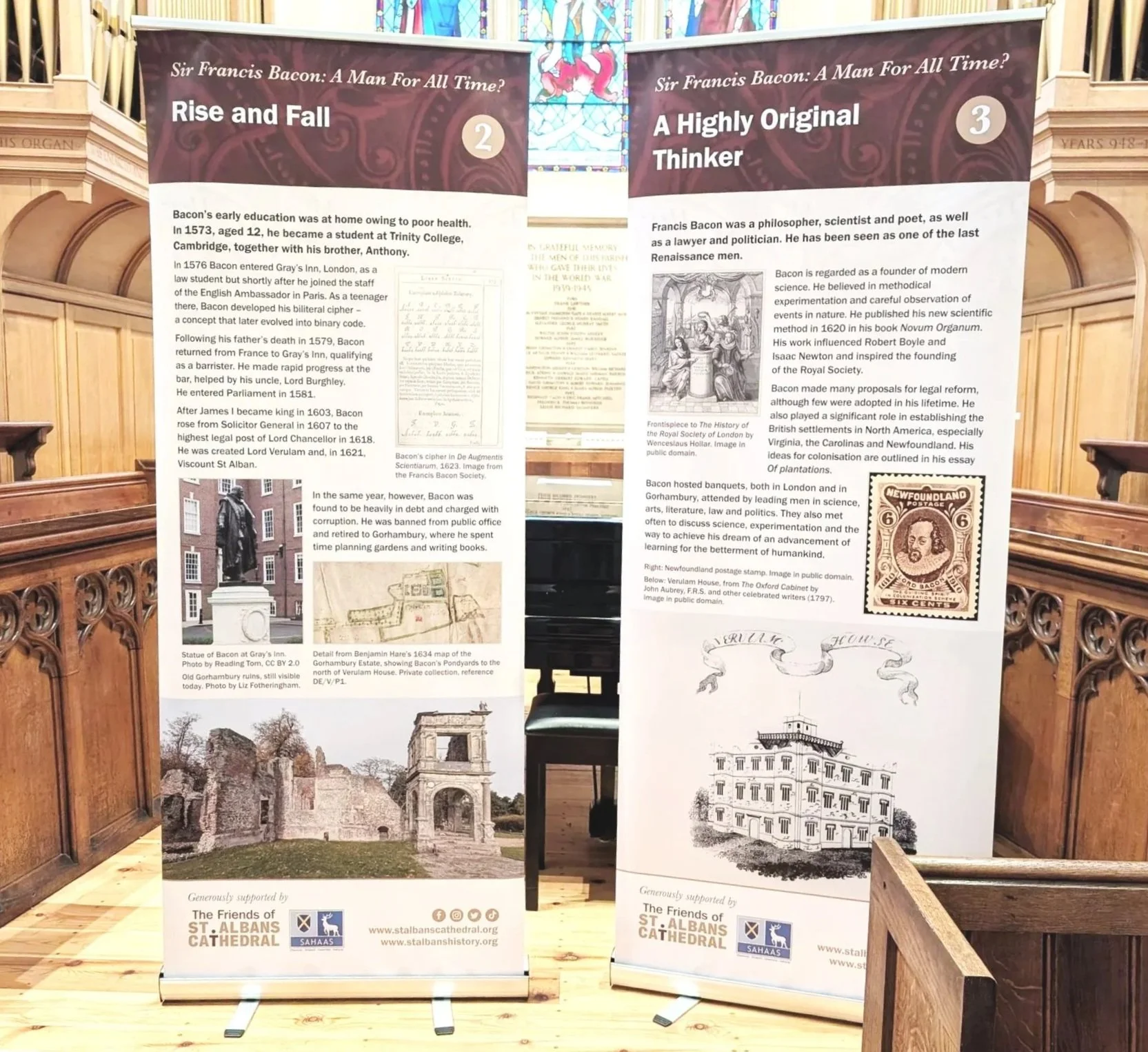
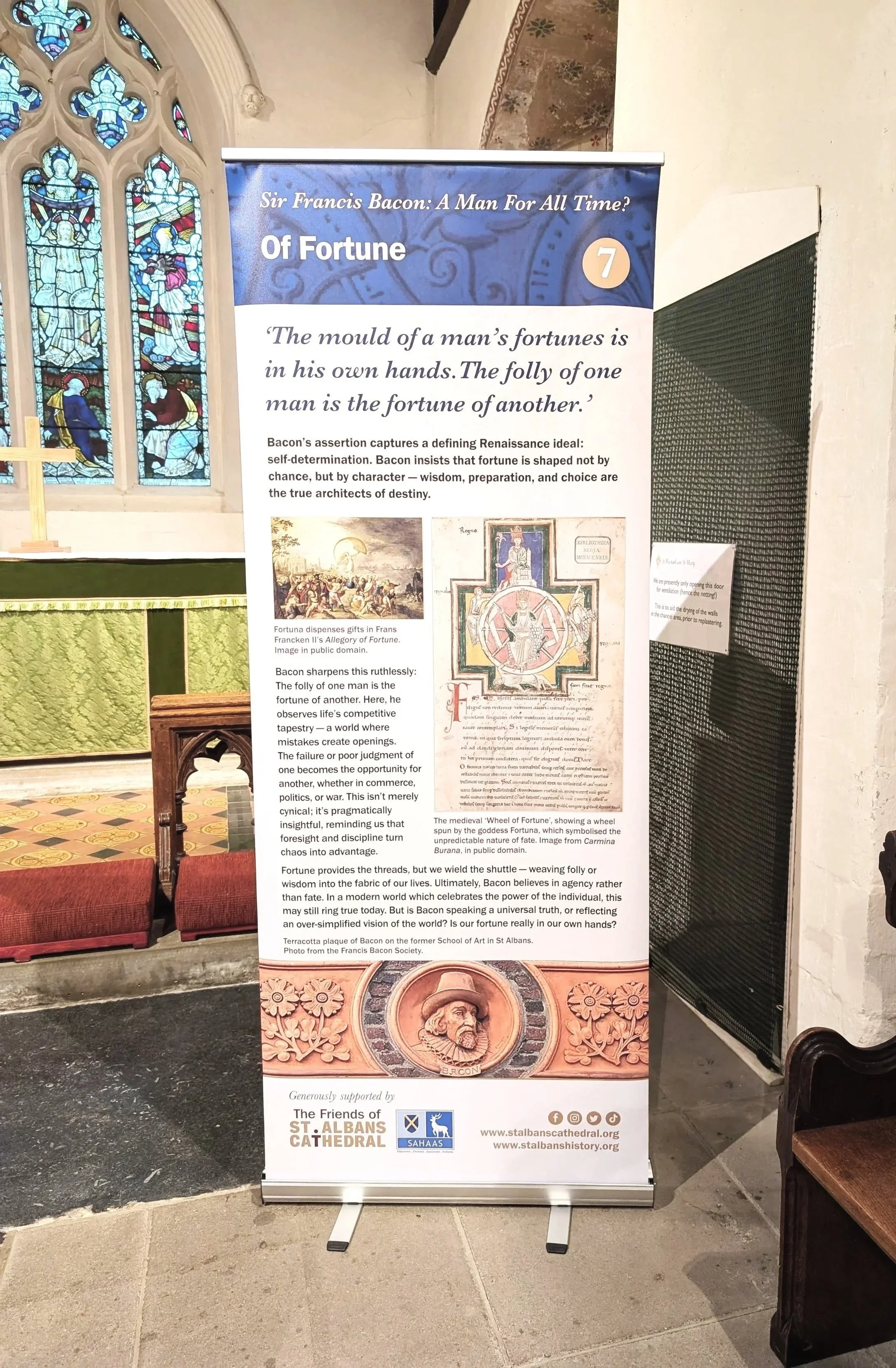
To find out more about key events and celebrations visit bacon400.com
Here you can find out everything celebrating the 400th anniversary of Sir Francis Bacon’s legacy.
Sir Francis Bacon 400th Anniversary Events Press Coverage
Mark Rylance & Peter Dawkins
Bacon, author of the modern world? An evening exploration
St Michael’s Church, 9th April 2026
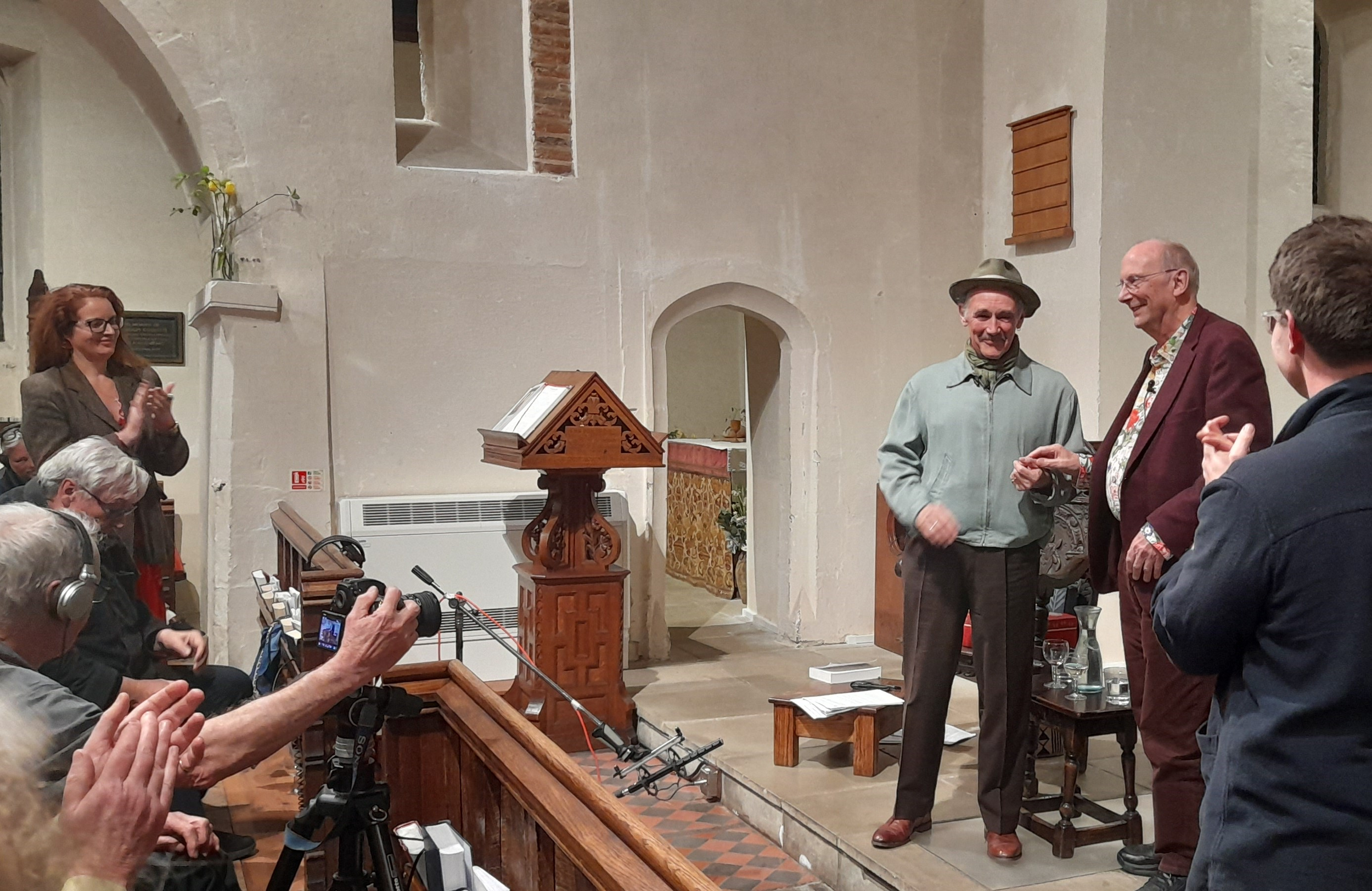
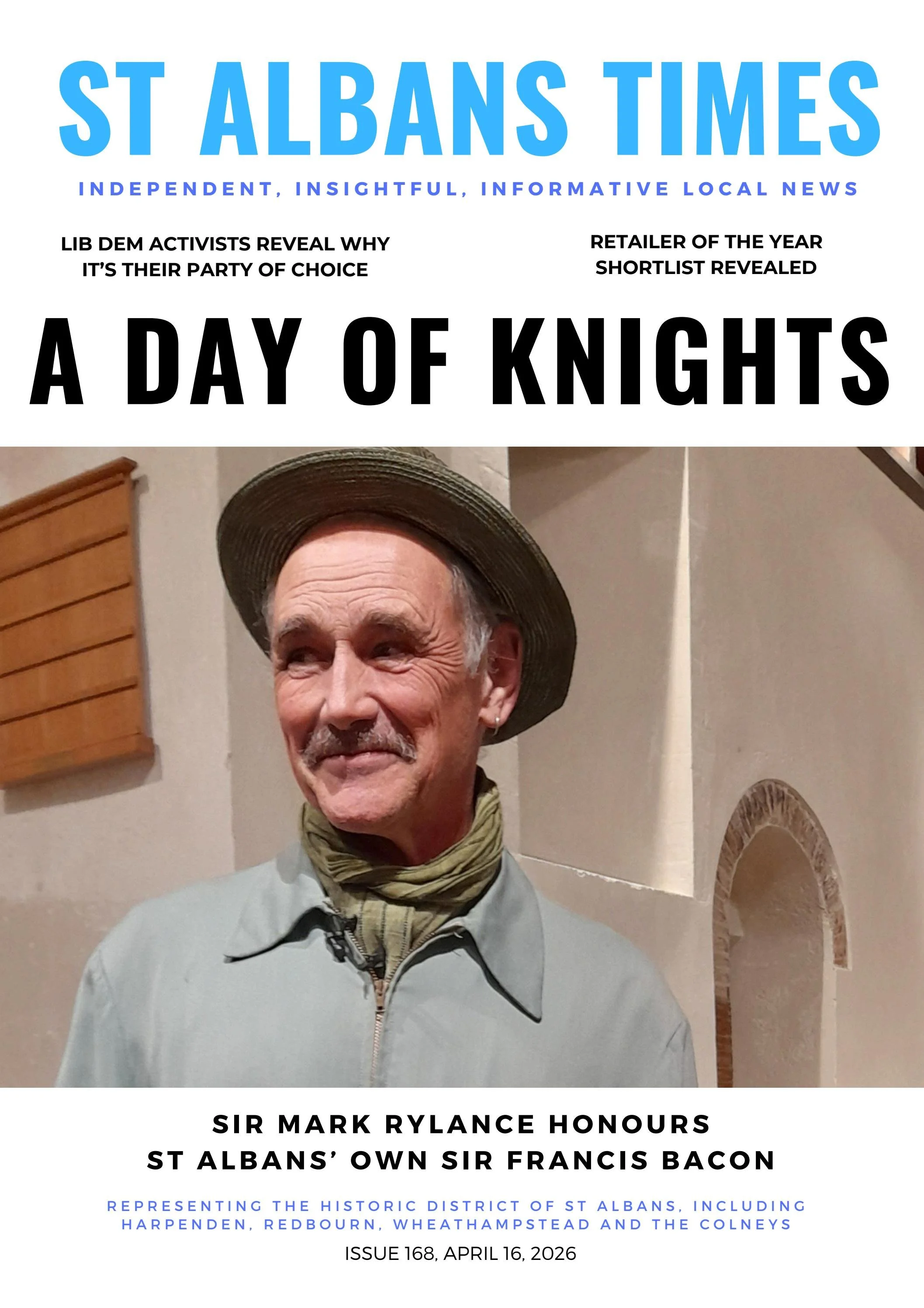
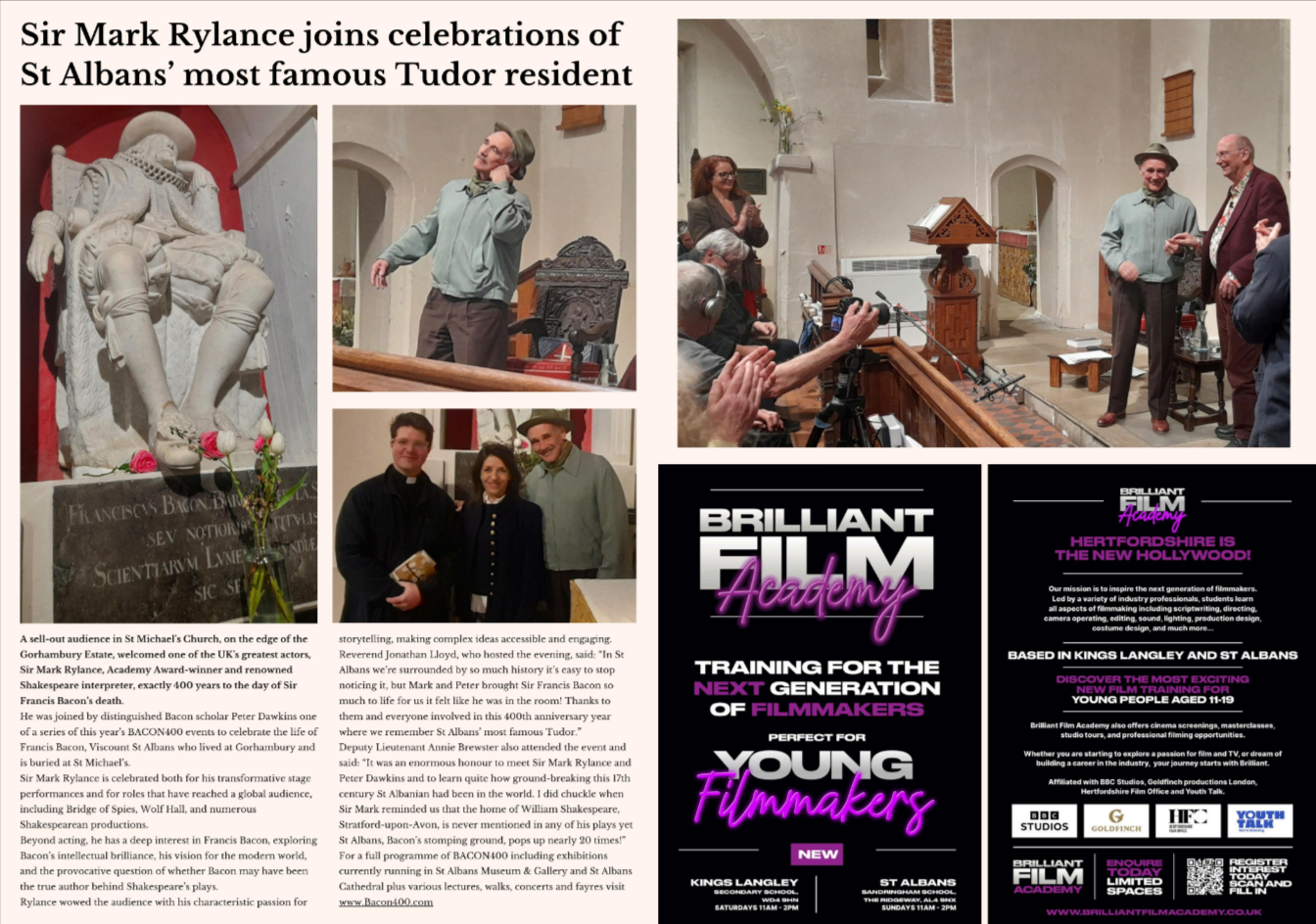
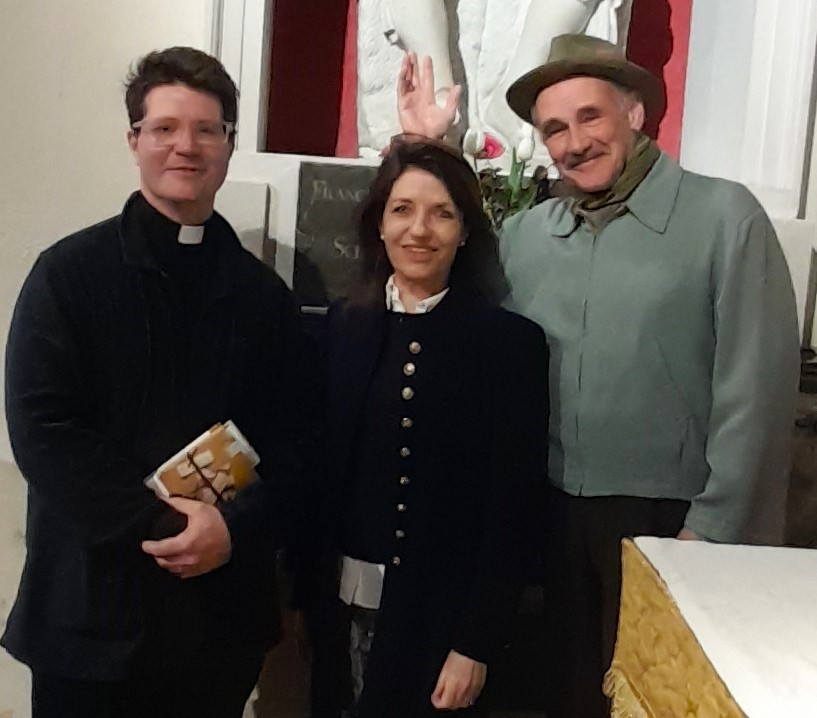
The above double page spread was recently published in the St Albans Times. To read the article or editorial in the St Albans Times, please click here: stalbanstimes.co.uk/latest-issue
To find out more about key events and celebrations visit bacon400.com
Here you can find out everything celebrating the 400th anniversary of Sir Francis Bacon’s legacy.
Sir Francis Bacon 400th Anniversary Press Coverage
The St Albans Times March 12th 2026
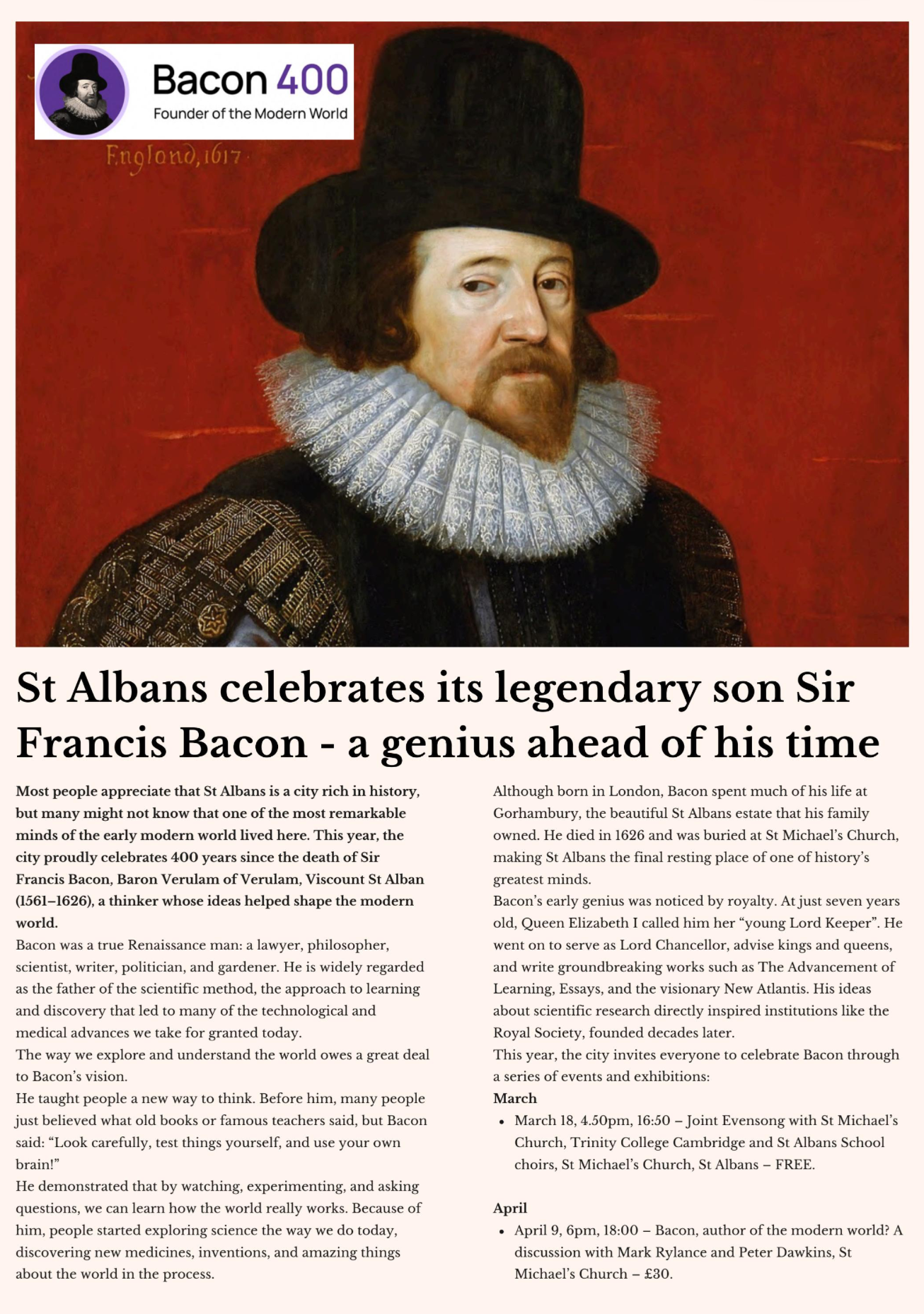
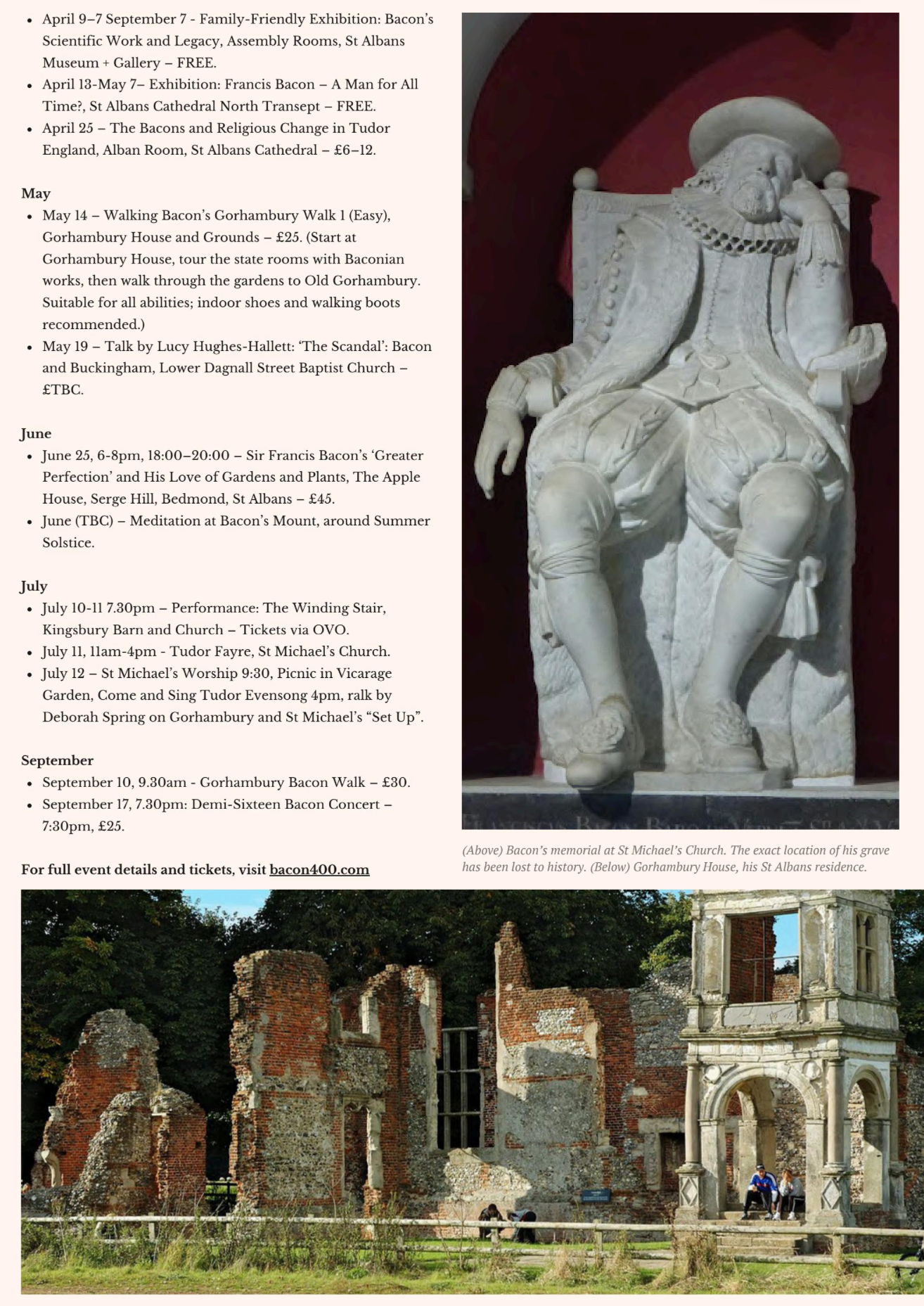
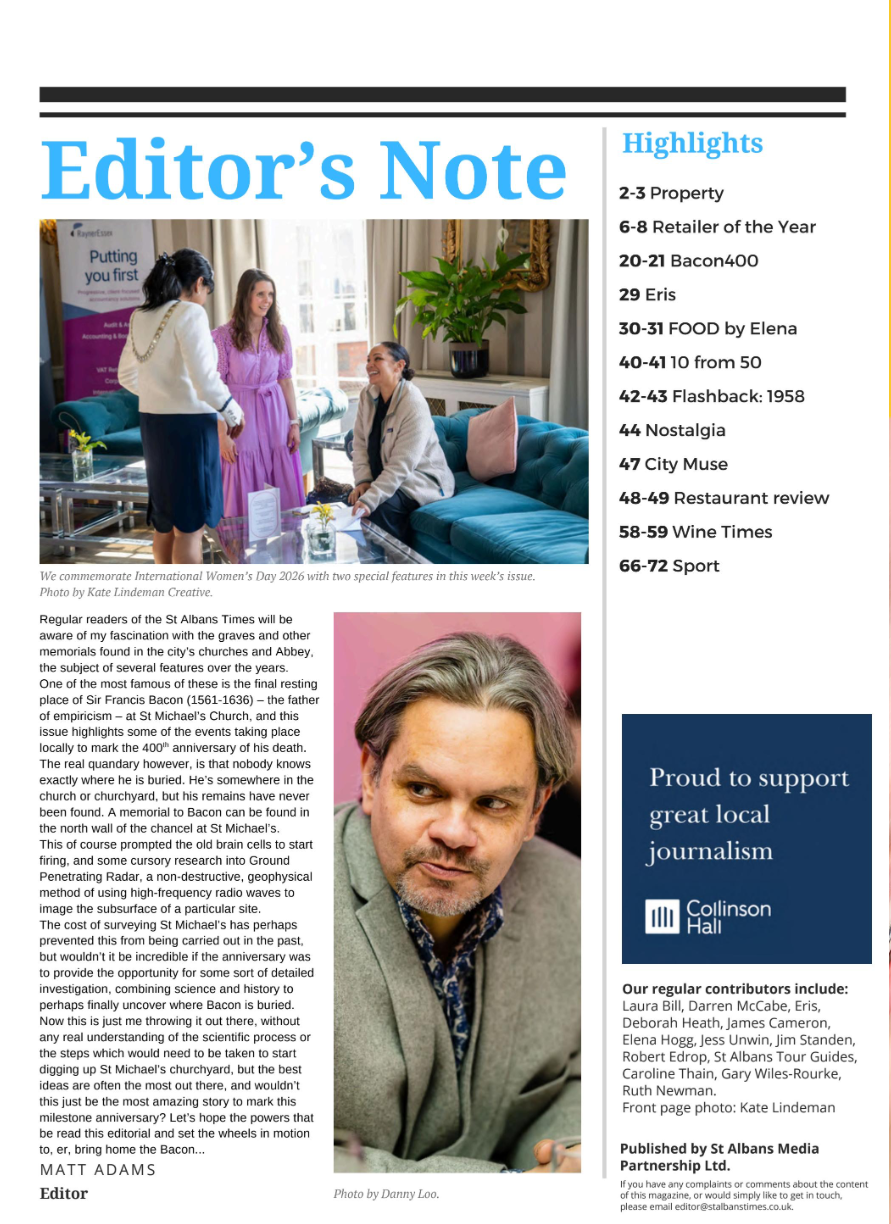
The above double page spread about this year’s commemoration of Sir Francis Bacon was recently published in the St Albans Times. The Editor’s Note for this issue (pictured below) carries the thought that now might be a good time to discover the exact place where he is buried - his remains have never been found. To read the article or editorial in the St Albans Times, please click here: stalbanstimes.co.uk/latest-issue
To find out more about key events and celebrations visit bacon400.com
Here you can find out everything celebrating the 400th anniversary of Sir Francis Bacon’s legacy.
The Parish
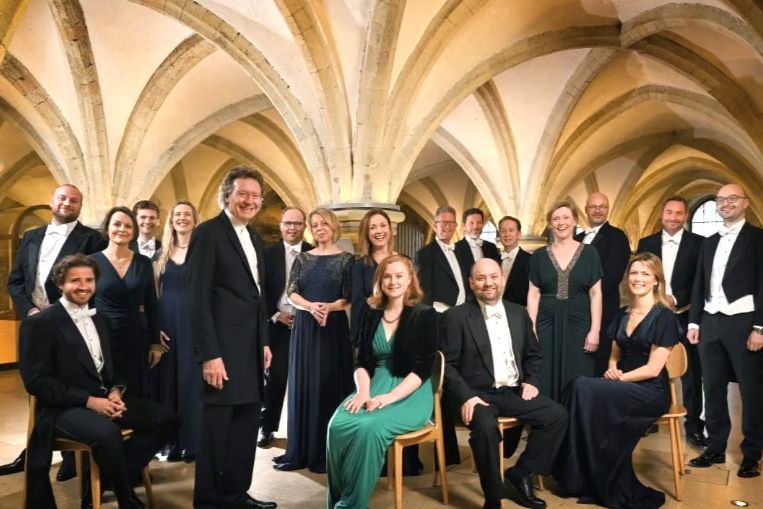
The Parish of St Michael’s St Albans with St Mary’s Childwickbury offers you a warm welcome. For over a thousand years the people of St Michael’s Village (now part of the city of St Albans) have come to this holy place to worship and pray, to bring their hopes and joys, and their fears and sorrows. Throughout the ages the sacraments of the Church have been celebrated, strengthening the people of God and supporting them on their pilgrimage through life. We hope and pray that you, too, may find in this place the peace of God and the assurance of His presence. The church has an outstanding choral and liturgical tradition and is open daily. Our main weekly service is at 9:30am on Sunday, and we welcome visitors of all ages.


